Blown-In Attic Insulation
The core job in the post-war stock: seal, baffle the eaves, then blow to a measured depth.
Post-war bungalows and semis with shallow attics, larger Humber Valley houses, and mid-rise and mixed-use buildings along the lakeshore — just east of our Mississauga base.
Etobicoke has some of the oldest housing stock we work in, and its post-war bungalows, 1.5-storey houses and semis share a consistent set of problems: shallow attic insulation, unsealed ceilings, and low eaves that are difficult to insulate without blocking ventilation.
Etobicoke sits directly east of us across Etobicoke Creek, and it is a noticeably older market than Mississauga or Brampton. Large parts of it were built between the late 1940s and the 1960s, and those houses were built to insulation standards that bear no resemblance to current practice.
The neighbourhoods of Alderwood, Long Branch, New Toronto, Mimico and the areas around Islington and Royal York are dominated by small detached houses from this era. What we find in them, consistently:
The usual scope is air sealing what can be reached, baffles at the eaves, and blown-in insulation to a proper measured depth. Knee walls and sloped sections usually need spray foam, because the geometry does not suit batts and the air sealing matters more there than anywhere.
With houses of this age, removal comes up more often than it does in newer areas. Decades of roof repairs, rewiring, ductwork additions and occasional wildlife leave attic insulation compacted, contaminated or water-stained. See attic insulation removal.
Some older attics contain vermiculite, a pebble-like loose-fill material, and some vermiculite may contain asbestos. If you think you have it, leave it undisturbed and arrange an assessment before anyone works up there.
We do not remove asbestos-containing materials. If we encounter vermiculite or anything we suspect could contain asbestos, we stop, we do not disturb it, and we advise that it be assessed and handled by appropriately qualified professionals. We can carry out the insulation work afterwards.
The Kingsway, Humber Valley Village, Edenbridge and Princess Anne Manor contain larger houses, many of them extensively renovated or rebuilt. The work here tends to be renovation-driven — insulating while walls are open, addressing additions built to a different standard than the original house, and dealing with the cathedral ceilings and complex rooflines that renovations tend to add.
Etobicoke has a lot of semi-detached housing, and party wall noise is a frequent enquiry alongside heat loss. Worth being clear: in an existing semi the party wall construction is fixed, you can only work from your own side, and the achievable improvement is real but bounded. Our soundproofing page explains why the whole assembly determines the result.
The Lake Shore Boulevard corridor and the Islington–City Centre area carry a mix of mid-rise residential, mixed-use and commercial buildings, along with older commercial stock through Mimico and New Toronto. Typical work:
See commercial insulation for how we handle occupied buildings, access windows and documentation.
The employment areas of south Etobicoke — around the Queensway, Kipling and the older industrial pockets near the lake — include a good deal of mid-century industrial stock. These buildings often need roof deck insulation and condensation control, and their age means substrate condition matters more than in newer buildings. See industrial insulation.
We are adding examples of completed Etobicoke projects here. Until we have permission to describe specific jobs, this section stays empty rather than invented.
Etobicoke work usually runs alongside jobs in the surrounding communities, all worked from our base in Mississauga.
The same six services as everywhere else, but the local building stock changes which ones come up. Here is what that looks like.
The core job in the post-war stock: seal, baffle the eaves, then blow to a measured depth.
Decades of roof repairs, rewiring and wildlife leave more material needing removal than in newer areas.
Knee walls and sloped ceiling sections in 1.5-storey houses, where batts do not suit the geometry.
Party walls in the semi-detached stock, and demising walls in lakeshore buildings.
Renovations and additions in Humber Valley and the Kingsway, while framing is open.
Mid-century industrial stock around the Queensway and Kipling.
Often yes, if what is there is dry and clean. The bigger issue in houses of that age is usually that the ceiling was never air sealed, so we seal the accessible penetrations first and then blow to a proper depth. If the existing material is compacted, stained or has had rodents in it, it comes out first.
Post-war bungalows and 1.5-storey houses have very low roof slopes at the eaves, so there is little room between the top of the ceiling joist and the underside of the roof. That is exactly where insulation gets thin and where blocking the soffit vents becomes a risk. Baffles keep the air path open, and the detail at the eaves is worth getting right.
The 1.5-storey design common in older Etobicoke neighbourhoods creates knee walls with unconditioned space behind them and sloped ceiling sections above. These are frequently under-insulated and rarely air sealed. They usually need a different approach from a flat attic — often spray foam, because the geometry does not suit batts.
It is possible in older houses. Vermiculite is a pebble-like loose-fill material, and some vermiculite may contain asbestos. If you think you have it, do not disturb it. We do not remove asbestos-containing materials — if we encounter something we suspect could contain asbestos we stop and advise that it be assessed and handled by appropriately qualified professionals.
We work on commercial and multi-unit buildings, though condominium work usually needs approval from the corporation and may be restricted by what counts as common element. Speak to your property manager first and let us know what has been approved.
Etobicoke holds a wider range of building ages than anywhere else on this site — pre-war houses, vast post-war bungalow tracts, 1960s apartment slabs and brand-new lakeshore towers, sometimes within a few blocks of one another.
Dense post-war bungalow and semi stock south of the Queensway. Small, low attics with shallow original insulation and ceiling planes that were never sealed — the most consistently worthwhile attic work in the area.
Older small houses immediately alongside modern condominium towers. Two entirely different sets of problems, often on the same street: shallow attics on one side, tenant-level acoustic and comfort issues on the other.
Larger houses from the 1920s to 40s, many extensively renovated. Additions joined to original structure, converted attics, knee walls and irregular framing that batts fit badly.
1960s and 70s detached built when attic depth was specified far below current practice. Generally sound, generally dry, and generally a straightforward top-up once the penetrations are sealed.
Post-war and 1960s housing alongside significant industrial land. A mix of ordinary residential attic work and commercial envelope enquiries within the same few square kilometres.
The airport-adjacent industrial and commercial belt. Warehouse and distribution space, hotels and offices, where scale and access matter more than intricate detailing.
These are characteristics of how Etobicoke was built, not a portfolio. We have not put project photographs or client names on this page, because there are none we have permission to publish — and a location page padded with invented local history is worth less than one that tells you what your building probably needs.
This area’s defining feature is how close its oldest and newest buildings sit to each other. The work each one needs has almost nothing in common.
Etobicoke’s post-war bungalow tracts are the clearest case for blown-in attic insulation anywhere we work: a single storey has more ceiling area relative to its floor area than any other house form, so attic depth matters more here than almost anywhere. Where the existing layer is wet, flattened or contaminated, it has to come out first — covering it over buries the problem rather than fixing it.
The extended and converted houses are a different job. Knee walls, sloped ceilings and additions joined onto original structure leave irregular cavities where spray foam conforms to what is actually there, while a straightforward basement or garage ceiling is better served by fibreglass batts. The semis and row housing raise party-wall questions that belong with sound-control work, and the industrial belt near the airport occasionally brings fire-protection enquiries alongside envelope work.
Etobicoke enquiries are mostly from homeowners, with a steady share from property managers of mid-rise and mixed-use buildings along the lakeshore. We are directly across Etobicoke Creek from our Mississauga shop, and work Brampton and Concord on the same rounds. If you are deciding between materials, this comparison of the three common options is the place to start, and we will assess the building before quoting anything.
The complaints here follow the building age closely, which is useful: the symptom usually points straight at the era, and the era points at the fix.
Single-storey houses have the largest ceiling area relative to their floor area of any form, so the attic matters more here than in a two-storey. Shallow insulation over an unsealed ceiling shows up as a whole-house complaint rather than one cold room.
Rooms built into the roof space with insulation stuffed behind the knee walls and nothing at the sloped ceiling. Common in the older, renovated stock, and usually a roofline job rather than a floor one.
Semis and row houses where the wall was built to the standard of its day. Absorption within the cavity helps; how much depends entirely on whether the two sides are structurally connected.
Corner units, top floors and suites next to mechanical rooms. These are almost always coordinated through the property manager, and the useful first question is what the building will allow rather than what the material can do.
The same range we run everywhere else. Each page explains what the work involves, where it suits, and — just as usefully — where it does not.
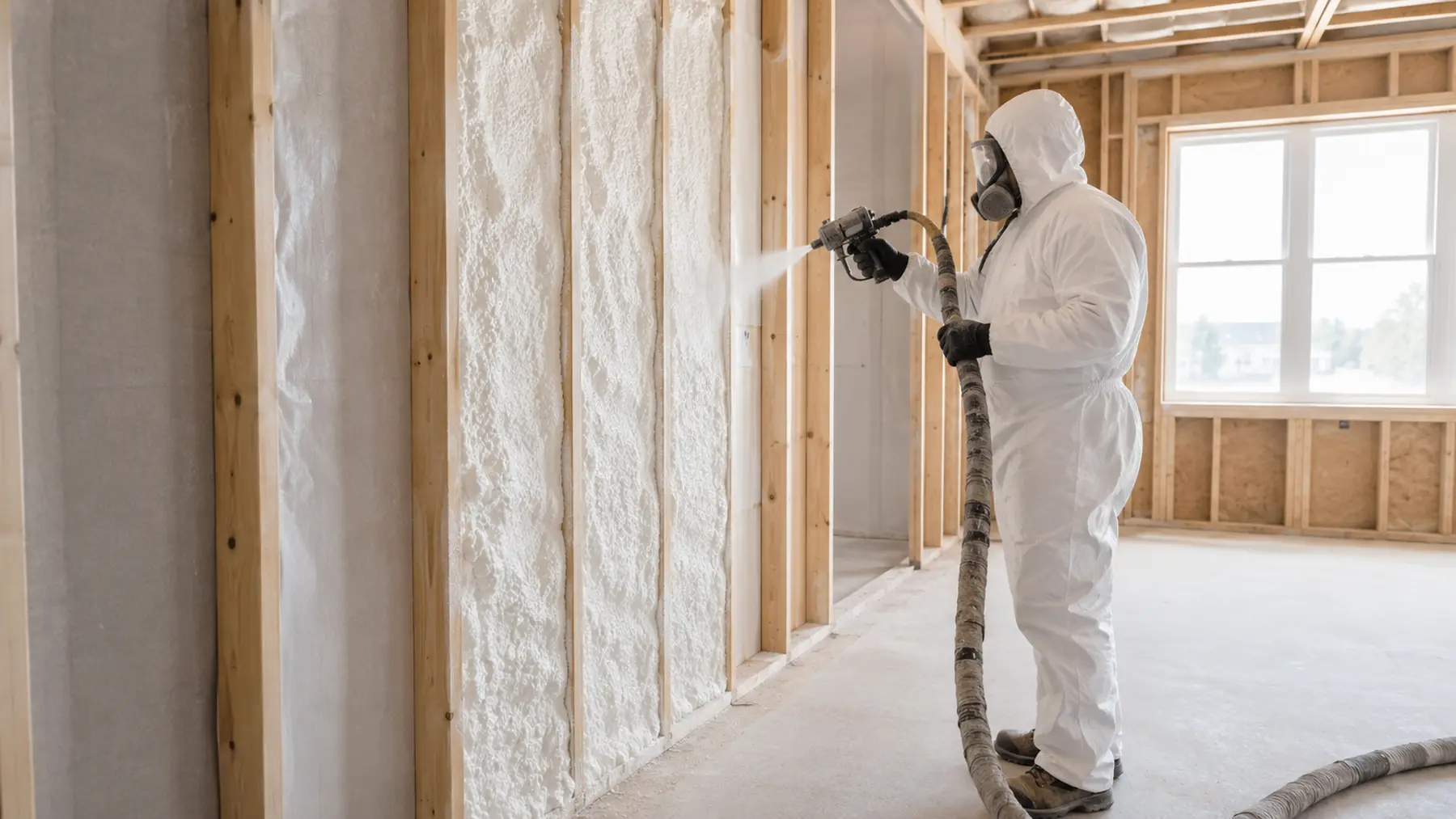
Open-cell and closed-cell polyurethane foam that insulates and air seals in a single application. Used in attics, walls, basements, crawl spaces and commercial envelopes.
Loose-fill fibreglass or cellulose blown across an attic floor to an even, measured depth. The usual choice for topping up an under-insulated attic.
Vacuum removal of old, damaged or contaminated attic insulation, with containment and disposal, so the attic can be air sealed and re-insulated properly.
Pre-cut fibreglass batts friction-fit into walls, ceilings, basements and garages. Cost-effective and dependable when it is cut and fitted correctly.
Spray-applied cementitious fire-resistive material and intumescent coatings for structural steel in commercial and industrial buildings.
Acoustic treatment for walls, ceilings and mechanical rooms in homes, offices and multi-unit buildings, planned around how sound actually travels.
Older houses reward a proper look before anyone quotes. Tell us the property and what it is doing, and we will come and assess it.