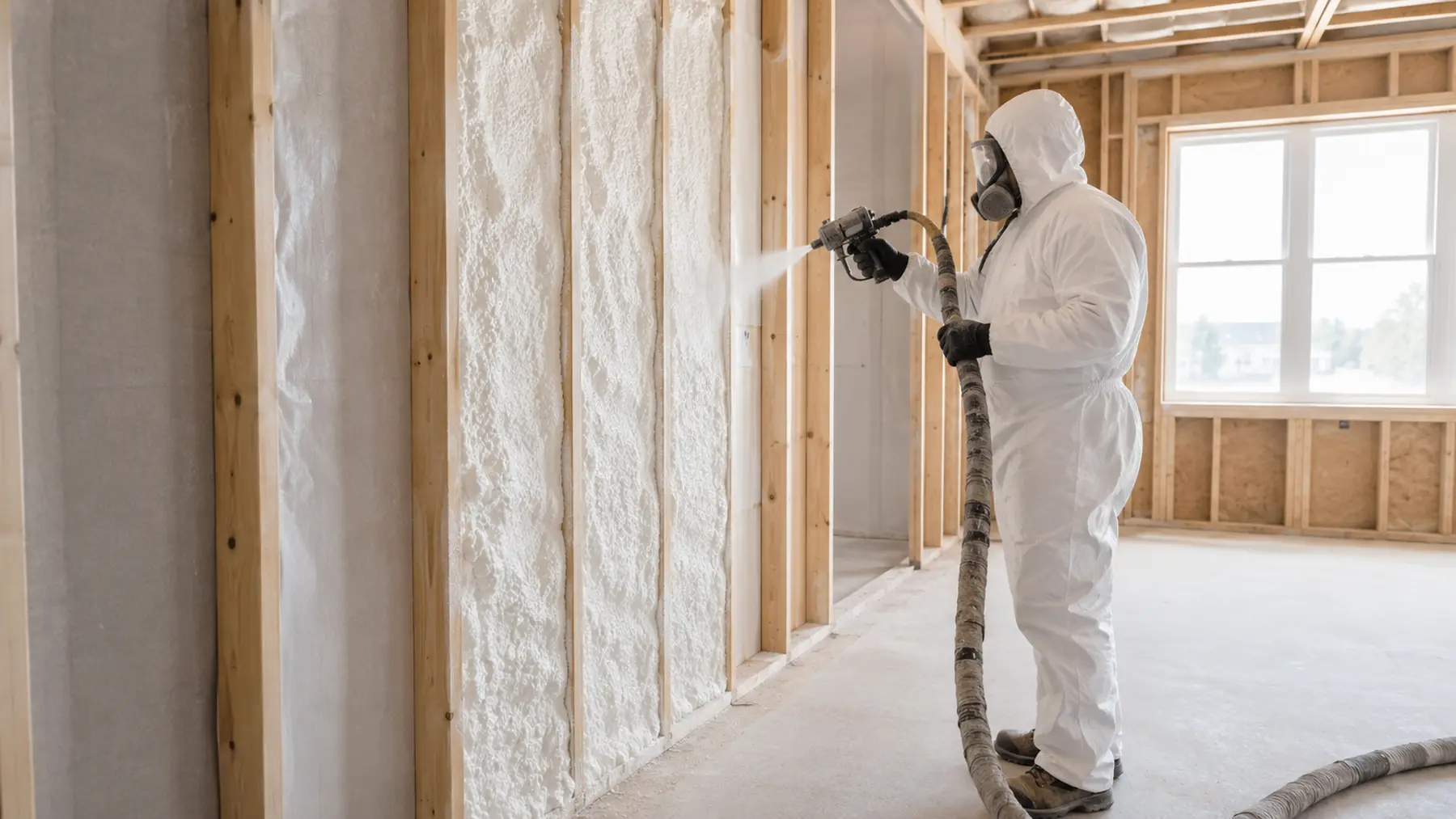
Spray Foam Insulation
Bonded to the underside of metal roof decks for condensation control, and to block and precast walls.
Warehouse, distribution and manufacturing envelopes through the Highway 7 and Keele corridor, plus residential work across Vaughan.
Concord sits in one of the densest industrial areas in the GTA, and most of our work there is envelope insulation and structural steel fireproofing in warehouse and manufacturing buildings — alongside residential projects in the surrounding Vaughan neighbourhoods.
Unlike most places we work, Concord’s defining characteristic is not its housing. The area between Highway 7, Keele Street, Dufferin and the 407 is one of the largest concentrations of warehouse, distribution and light manufacturing space in the Greater Toronto Area, and that is where the majority of our Concord work sits.
These buildings are mostly precast or tilt-up concrete with steel roof structure and metal deck. That combination produces a predictable set of insulation problems.
This is the most common reason a Concord industrial client calls us, and it is regularly mistaken for a roof leak. Warm moist air inside the building reaches the cold underside of the deck and condenses there. Water drips onto stock, racking and floors. It happens in cold weather, it is not tied to any roof penetration, and roofers find nothing wrong.
Spray foam applied to the underside of the deck raises its surface temperature so it stays above the dew point. Foam suits this because it bonds directly to the deck with no gap behind it — a gap would let moist air reach the cold steel regardless of what was in front of it.
Buildings converted to temperature-sensitive use — food distribution, pharmaceutical storage, climate-controlled logistics — need envelope performance the original shell was never built for. Continuity matters more than raw thickness here: an interruption at a junction or a penetration becomes both a condensation point and a persistent loss.
Almost every industrial unit has an office area, and many have mezzanines added later. These are conventional framed assemblies inside a large shell, insulated with fibreglass batts, often with an acoustic requirement where offices sit against the warehouse floor.
Applied fire protection to structural steel is a routine requirement on industrial construction and renovation in the area. We carry out that scope — see fireproofing — and where a project needs both insulation and fire protection, holding both packages removes a coordination interface between two trades working at height on the same structure.
How we approach this work in detail: industrial insulation.
Concord industrial buildings are working buildings. Distribution operations run to schedules that will not move for an insulation contractor, and the practical reality is that we work in zones, in phases, and frequently out of hours.
The residential areas of Vaughan surrounding Concord — including the neighbourhoods along Dufferin and Keele and the newer communities north of Rutherford — are largely 1990s and later, with a significant share of large custom and semi-custom homes.
That produces a different residential job mix from, say, Etobicoke:
These are usually targeted spray foam jobs rather than straightforward attic top-ups. See residential insulation.
We are adding examples of completed Concord projects here. Until we have permission to describe specific jobs, we would rather leave this section empty than invent them.
Concord work usually runs alongside jobs in the surrounding communities, all worked from our base in Mississauga.
The same six services as everywhere else, but the local building stock changes which ones come up. Here is what that looks like.
Bonded to the underside of metal roof decks for condensation control, and to block and precast walls.
Structural steel on industrial construction and renovation, cementitious or intumescent.
Office and mezzanine build-outs inside a larger shell.
Offices sitting against a working warehouse floor, and mechanical rooms.
Attic compartments in the surrounding Vaughan housing.
Clearing attic floors before air sealing on residential work.
That is almost certainly condensation rather than a leak. Warm moist air inside the building reaches the cold underside of the metal roof deck, condenses on it and drips. It appears in cold weather, it is not tied to any roof penetration, and it stops when the weather warms. Insulating the underside of the deck raises its surface temperature so it stays above the dew point.
Usually yes, with the work area zoned off and the sequencing agreed in advance. Spray foam application needs the immediate area cleared and ventilated, so we plan the phasing with your operations team rather than assuming you can shut down.
We work around it where we have to, but coverage above fixed racking is limited and it costs more for a worse result. If a section of racking can be moved or emptied for a short window, the finished job is better. We will tell you what is realistic after walking the space.
Yes. The residential areas of Vaughan around Concord include a lot of large custom and semi-custom homes from the 1990s onward, which tend to have complex roof geometry, cathedral ceilings and sizeable cantilevered areas — targeted spray foam work more often than whole-attic top-ups.
Yes. Structural steel fire protection is a common requirement on industrial construction in the area, and holding both the insulation and fireproofing packages removes an interface between two trades working on the same structure at height.
Most of Concord is industrial and commercial land rather than housing, which makes it unlike the other two areas on this site. The residential work sits around the edges, in Vaughan, and the bulk of the enquiries are about buildings people work in rather than live in.
The spine of the district. Warehousing, distribution and light manufacturing in units of every size, much of it built from the 1970s onward and now on its second or third tenant.
Larger single-tenant buildings and multi-unit industrial condominium blocks. Metal roof decks and block walls, where a sprayed product covers ground far faster than a cut one.
Distribution space positioned for the highway network, typically high-clear and largely open inside. Envelope work here is about large areas and coordinated access rather than intricate detail.
The high-rise and mixed-use development at the subway terminus, immediately south-east. Occupied buildings, tenant fit-outs, and acoustic separation between uses stacked on top of each other.
The original residential pocket, older than the industrial land that grew around it. Small detached houses with the attic and basement issues that come with their age.
The 2000s residential subdivisions north and west. Two-storey detached and townhouse blocks where the recurring complaints are garages under bedrooms and cold basements rather than shallow attics.
These are characteristics of how Concord was built, not a portfolio. We have not put project photographs or client names on this page, because there are none we have permission to publish — and a location page padded with invented local history is worth less than one that tells you what your building probably needs.
Industrial and residential work in this area share a shop and a crew, and almost nothing else. Scheduling, access, protection and documentation all change completely between the two.
Concord work is mostly about envelopes rather than attics. Metal roof decks and block walls suit sprayed foam, which covers large uninterrupted surfaces quickly and handles the transitions a cut product leaves open, while office fit-outs and demising walls inside those buildings are ordinary batt work. Where structural steel has been identified as needing protection, that is a fire-protection package with its own specification and its own documentation — not an insulation upgrade.
The residential edges of the area behave like anywhere else in the GTA: shallow attics in the older housing want blown-in top-ups, damaged material needs taking out first, and mixed-use buildings around the Vaughan Metropolitan Centre raise separation questions that belong with acoustic work.
This is the most business-to-business of our three area pages. Most enquiries come from warehouse and manufacturing operators, commercial property managers and general contractors tendering a package. We work Concord from Mississauga, alongside Brampton and Etobicoke. Send the drawings and the specification and we will price what has actually been specified.
The enquiries from this area skew commercial, and the questions behind them are different from the ones a homeowner asks.
Warm, humid inside air meeting a cold steel deck produces condensation that lands on stock and equipment. It is a vapour and air-movement problem, and the fix has to be chosen for the assembly rather than the symptom.
Older industrial envelopes with thin or absent insulation, large doors and considerable air leakage. The realistic answer is usually staged — the biggest, most reachable losses first.
Structural steel identified as needing applied protection, with a specification, drawings and often an engineer behind it. We work to what has been specified and do not quote a rating we cannot evidence for the complete assembly.
Mixed-use and multi-unit buildings where mechanical plant, commercial hours and residential occupancy sit close together. What is carrying the sound decides whether insulation is most of the answer or a small part of it.
The same range we run everywhere else. Each page explains what the work involves, where it suits, and — just as usefully — where it does not.
Open-cell and closed-cell polyurethane foam that insulates and air seals in a single application. Used in attics, walls, basements, crawl spaces and commercial envelopes.
Loose-fill fibreglass or cellulose blown across an attic floor to an even, measured depth. The usual choice for topping up an under-insulated attic.
Vacuum removal of old, damaged or contaminated attic insulation, with containment and disposal, so the attic can be air sealed and re-insulated properly.
Pre-cut fibreglass batts friction-fit into walls, ceilings, basements and garages. Cost-effective and dependable when it is cut and fitted correctly.
Spray-applied cementitious fire-resistive material and intumescent coatings for structural steel in commercial and industrial buildings.
Acoustic treatment for walls, ceilings and mechanical rooms in homes, offices and multi-unit buildings, planned around how sound actually travels.
Warehouse condensation, an envelope package, a fireproofing scope or a house in Vaughan — tell us the building and we will come and walk it.